









What Is Arbitrage Betting?
Arbitrage betting, also known as sure bets, involves backing every possible outcome of an event at prices that produce a positive calculated return.
An arbitrage calculator works out how to divide your stakes so the payouts cover your total investment.
Unlike ordinary online betting, you’re looking for a pricing difference between sportsbooks rather than trying to predict which team wins.
Why Do Sportsbooks Offer Different Odds?
An NFL quarterback gets ruled out, and one sportsbook moves the line immediately. Another takes longer. For a short window, the same game has two noticeably different prices.
Different trading models and betting activity can also create gaps. Since betting apps set their own odds, those differences are common. Finding prices that bring the combined implied probability below 100% is much less common.
How to Use Our Arbitrage Calculator
A free arbitrage calculator is particularly useful when the two sides have different odds. Splitting $500 evenly between +150 and -125, for example, leaves very different potential payouts.
Enter the odds and total stake to calculate the appropriate amounts. For related calculations, the other betting calculators cover odds conversions, hedging, and sportsbook margins.
Step 1: Find the Best Odds for Each Outcome
Compare prices for the same event across different sportsbooks.
For an NBA moneyline, find the highest odds on each team. A standard soccer match result requires three prices because a draw is also possible.
Pay attention to the market description. A bet on a soccer team’s 90-minute result isn’t the same as betting on that team to advance.
Step 2: Enter the Odds
Add the prices for every possible outcome.
Most US sportsbooks display American odds. A price of +150 means a $100 winning stake earns $150 in profit. At -120, you’d need to wager $120 to earn $100.
Check the positive and negative signs carefully. Entering +110 instead of -110 changes the calculation considerably.
Step 3: Choose Your Total Stake
How much are you comfortable putting across the entire market?
You might choose $200 for a small opportunity or $1,000 when the available limits allow it.
The amount isn’t automatically divided evenly. Different odds require different stakes to produce matching payouts.
You’ll also need enough money in each sportsbook account to place its portion.
Step 4: Calculate and Review the Results
Run the calculation and look at the stake assigned to each outcome.
Compare the possible payouts with your total investment. A positive result indicates an arbitrage opportunity at the entered prices.
Before placing the wagers, check the odds again. Also confirm that each sportsbook will accept the full amount. A rejected or reduced stake changes the calculation.
How to Calculate Arbitrage Bets
Every sure bet calculator relies on implied probability.
Betting odds tell you how likely an outcome is according to the price being offered. Add the implied probabilities for every possible result, and you’ll get the combined market probability.
When that total falls below 100%, there’s room for a positive calculated return.
At 100% or higher, standard equal-return arbitrage staking won’t produce a profit.
The Arbitrage Formula
Start by converting American odds to decimal odds.
For positive odds:
Decimal odds = 1 + (American odds ÷ 100)
For negative odds:
Decimal odds = 1 + (100 ÷ absolute American odds)
Next, calculate the combined implied probability:
Combined probability = (1 ÷ Odds A) + (1 ÷ Odds B)
Add a third term for three-way markets.
To divide your bankroll:
Individual stake = Total stake × (1 ÷ Outcome odds) ÷ Combined probability
Finally, calculate the return:
Profit = (Total stake ÷ Combined probability) − Total stake
These formulas use decimal odds and assume every wager is accepted and settled at the entered prices. Whether you’re using an arbitrage betting calculator or working through the figures yourself, the underlying math is the same.
Worked Example: 2-Way Moneyline Arbitrage
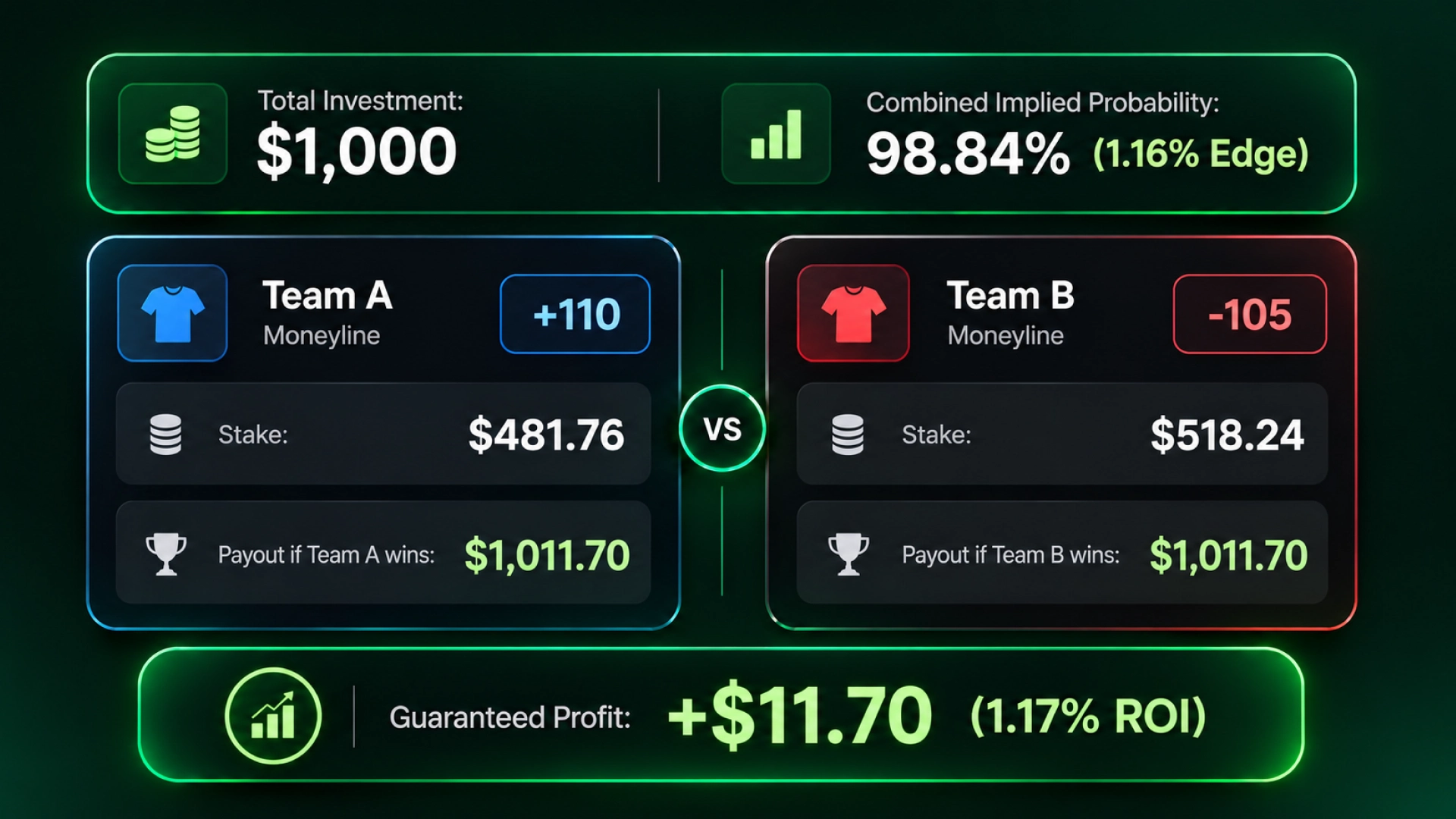
Sportsbook A offers Team A at +110 (2.10). Sportsbook B has Team B at -105 (1.95238).
First, check the implied probabilities:
(100 ÷ 210) + (105 ÷ 205) = 98.84%
That’s a 1.16-percentage-point gap below 100%.
For a $1,000 total investment, the stake formula gives:
Team A: $1,000 × (1 ÷ 2.10) ÷ 0.9883856 = $481.79
Team B: $1,000 × (1 ÷ 1.95238) ÷ 0.9883856 = $518.21
| Selection | Odds | Stake | Gross payout |
| Team A | +110 | $481.79 | $1,011.76 |
| Team B | -105 | $518.21 | $1,011.74 |
The lower payout gives $11.74 in calculated profit, or approximately 1.17% ROI, if both wagers are accepted and settled at those odds.
Notice that the stakes aren’t equal. That’s what keeps the payouts close.
Weighted Stakes: Leaning Toward One Outcome
What if you prefer Team B and want more of the potential profit on that result?
You can adjust the stakes rather than aiming for equal payouts.
Using the same $1,000 investment, put $476.19 on Team A at +110. That returns approximately $1,000 if Team A wins.
The remaining $523.81 goes on Team B at -105, producing around $1,022.68 if Team B wins.
The calculation now favors Team B. It’s a different approach from equal-return arbitrage, and rounding can leave a small loss on the lower-paying outcome.
What Is the Difference Between 2-Way and 3-Way Arbitrage?
A sports arb calculator needs to account for every possible result, and the number of outcomes depends on the market.
NFL, MLB, NBA, and tennis moneylines typically have two possible winners. That makes the calculation relatively simple.
Soccer’s standard three-way result market includes a home win, draw, and away win. All three need to be covered.
Suppose the odds are +150, +300, and +200.
(1 ÷ 2.50) + (1 ÷ 4.00) + (1 ÷ 3.00) = 98.33%
With $600 invested, the formula produces stakes of approximately $244.07, $152.54, and $203.39.
The minimum rounded profit is about $10.16 if all three bets are accepted and settled at those odds.
A sports betting arbitrage calculator is particularly useful here because dividing stakes evenly across three outcomes would produce very different payouts.
How to Find Arbitrage Opportunities in November 2026
A good arbitrage price rarely sits around waiting to be found. Sportsbook lines change throughout the day, and some opportunities disappear within minutes.
Comparing prices regularly helps, but the most useful opportunities are those where every required wager can actually be placed.
Compare Odds Across Sportsbooks
The best price on Team A might be at one sportsbook, while another offers a better number on Team B.
That’s where odds comparison becomes useful.
Imagine an NFL matchup with +115 on one team and -105 on the other.
(100 ÷ 215) + (105 ÷ 205) = 97.73%
Those odds produce a theoretical ROI of approximately 2.32%.
The important part is comparing opposing selections from the same market. Two attractive prices mean little if they don’t cover every possible result.
Automated Arb Scanning Tools
A price difference can disappear in the time it takes to open another sportsbook. That’s the problem with checking every market manually, especially when dozens of games are available.
Automated scanners compare sportsbook odds and flag combinations with a total implied probability below 100%. They’re built to find opportunities quickly, not decide how much money belongs on each outcome.
An arb calculator handles the stake calculations. Sportsbook limits and settlement rules still determine whether the opportunity is practical.
Exploit Sportsbook Promotions and Odds Boosts
Odds boosts can create interesting price differences, particularly when the opposing side remains available at its normal price.
Suppose Team A gets boosted to +130 while another sportsbook offers Team B at -110.
(100 ÷ 230) + (110 ÷ 210) = 95.86%
That’s a calculated ROI of approximately 4.32%.
Now imagine the boost has a $10 maximum stake. The opportunity still exists mathematically, but its value is much smaller than the percentage initially suggests.
Check the stake caps and eligibility terms attached to the best sportsbook promos before using boosted prices in a calculation.
Risks and Limitations of Arbitrage Betting
A 2% calculated return looks good until the second sportsbook rejects half the required stake.
That’s a common practical problem with arbitrage betting. Odds can move between wagers, accounts can have betting limits, and sportsbooks may void bets under their rules. Even with accurate calculations, the final result depends on getting every required wager accepted and settled correctly.
Palpable Errors and Voided Bets
A sportsbook accidentally lists a heavy favorite at +250 instead of -250. The price looks incredible, but it could be an obvious mistake.
These situations are known as palpable errors.
Sportsbooks may have rules allowing them to void wagers placed at clearly incorrect prices.
If the first sportsbook cancels your bet after you’ve already backed the opposite outcome elsewhere, you’re left holding an ordinary wager rather than an arbitrage position.
An unusually generous line deserves a closer look at the operator’s rules.
Odds Movement and Rejected Bets
Here’s a frustrating scenario. You place $300 on Team A at +120, then switch sportsbooks to back Team B.
The second price has moved from -105 to -130.
Your original stake calculation is now outdated. The new odds may remove the potential profit entirely.
A rejected wager causes a similar problem. Even a partial acceptance can leave the two sides unbalanced.
For small margins, a relatively minor price change can wipe out the calculated return.
Account Limits
A 3% arbitrage opportunity on $2,000 would produce $60 in calculated profit. But if one sportsbook accepts only $20, the original stake breakdown is useless.
Limits vary by market, promotion, and account. An NFL moneyline might allow a $500 wager, while a boosted player prop has a $25 cap.
Sportsbooks can also reduce limits on accounts that regularly exploit pricing differences. The available stake matters just as much as the advertised odds.
Arbitrage vs. Hedging: What Is the Difference?
The difference comes down to why and when the opposing wagers are placed.
With arbitrage, you’re looking for a pricing discrepancy and placing bets across every possible outcome while those prices remain available.
Hedging usually starts with a wager you’ve already made.
Say you bet $25 on an NFL team to win the Super Bowl before the season. That team reaches the final, and its opponent is now available at attractive odds.
You might place another bet to reduce your exposure or secure some of the potential payout.
A hedging calculator helps work out those amounts.
Arbitrage begins with the combined prices. Hedging begins with an existing position and a decision about how much risk to keep.