












What Are Betting Odds and How Do They Work?
Sports betting odds reflect the likelihood of an outcome in a sporting event. In essence, they dictate the relationship between risk and reward. Of course, the riskier something is, the higher the reward. In contrast, something that’s not risky brings small prizes.
The most basic odds are those for “favorites” and “underdogs”. For example, you bet on the Kansas City Chiefs to win over the Las Vegas Raiders. The odds of the City Chiefs winning are -150. This means that you have to bet $150 to make a $100 profit ($250 total payout).
On the other hand, the odds for the weaker team, the Raiders, to win are +130. This implies that a $100 wager yields a $130 profit ($230 in total).
Now that you have the basic betting odds explained, let’s learn about the odds types and other key odds concepts.
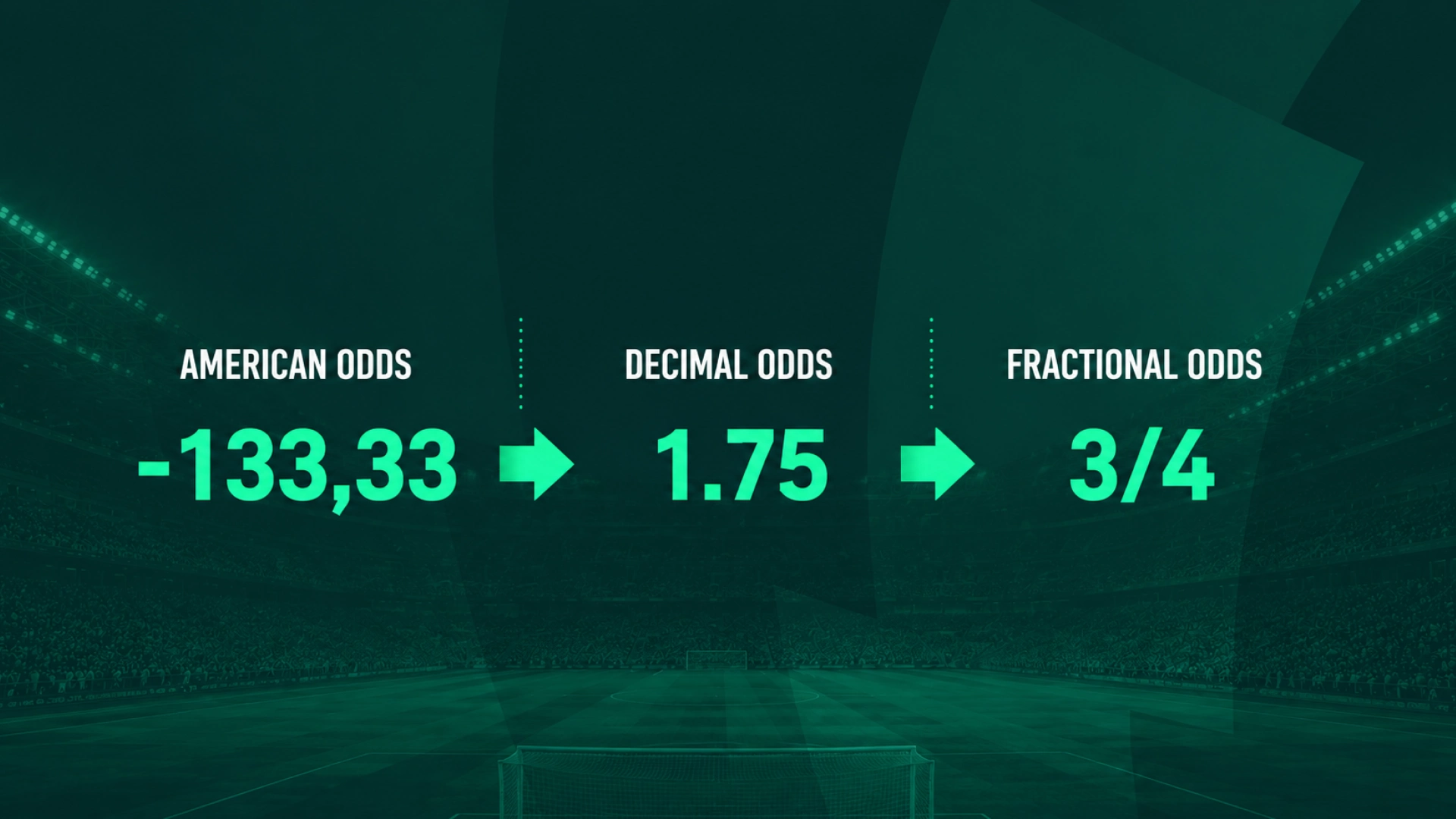
American Odds Explained — What Does +/- Mean?
As pointed out, the standard odds are for favorites and underdogs. The favorite odds are negative (with the “-” sign), whereas the underdog odds are positive (no sign or the “+”).
Moreover, understanding betting odds means recognizing that the probability of a favorite winning is higher, while the likelihood of an underdog winning is lower.
Still, betting lines on sportsbook sites aren’t only about probability or likelihood, because they also have “vig” or “juice”. This is an additional odds entity by which sports operators make a profit.
What Is the Vig or Juice in Betting Lines?
Online sportsbooks take wagers from bettors, suggesting they act as intermediaries between events and users. Because of this, books have “juice” or “vig” (vigorish), a built-in fee they charge for accepting bets.
This is sort of a margining, by which brands ensure profit regardless of the outcome. Here’s an example:
- A sportsbook proposes odds of -110 for both teams on a spread bet.
- Two people bet on the opposite outcomes, and the book gets $220.
- One person wins and gets $210 ($100 stake return and $110 profit).
- The brand is left with $10 (profit).
Decimal Odds Explained
Decimal betting odds use single numbers to show the total payout a bettor receives (stake + profit). The payout is calculated by multiplying your stake by the odds (e.g., a $20 wager at 1.50 odds equals a $30 total payout).
To detect favorites, just look for a lower odds number (e.g., the 1.35 odds for the Dodgers to win in a match against the Rays, whose winning odds lie at 2.40). So, here, the probability of the Dodgers winning is higher than that of the Rays winning.
This odds variant is commonly used for soccer and tennis, and predominantly in Europe.
Fractional Odds Explained
Fractional sports betting odds are the third type of odds, mostly used in the UK and for horse racing bets. They consist of two numbers, the higher number (the numerator) and the lower number (the denominator).
The first number shows the profit a bettor makes, and the second number stands for the stake. For instance, a $10 bet with a $50 profit would be presented as a 5/1 fraction. The higher fractions are for underdogs, while the lower ones are for favorites.
How to Read Betting Odds — A Step-By-Step Guide
American or moneyline odds are generally simpler to interpret than fractions. So, we’ll focus on them to demonstrate how to find out betting odds meaning, or how to understand betting odds in simple steps. Here they are:
- Identify the side: Based on the sign (– or +), you can tell which team or player has which status— the – sign is for favorites, and the + sign is for underdogs.
- Read the odds: Moneyline odds show you how much you risk or win based on a $100 standard.
- Calculate returns for favorite: If you have -120 odds for a favorite, it means you risk $120 for a $100 profit.
- Calculate returns for underdog: The positive or underdog odds display how much profit you make for a $100 bet. To exemplify, you’ll have to bet $100 at +180 odds to make a $180 profit.
What Does +200 Odds Mean?
Odds of +200 mean you need to wager $100 to win $200. Since we see the + sign, it means it’s for an underdog in a match. And this sign is directly related to the profit in dollars we can make by placing a standard $100 bet.
What Does -300 Odds Mean?
-300 odds mean that you have to stake $300 to earn $100. First, we identify the – sign, symbolizing a favorite in a game. The same sign also indicates the amount we must wager to achieve a standard $100 profit.
What Does +10000 Odds Mean?
+10000 odds mean that with a $100 wager, you can potentially win $10,000 plus your stake back. It’s the example of massive “long-shot” odds that’s typically used for future markets, where you predict an outcome in the long run (e.g., the NBA tournament champion before the season begins).
This market has a very low implied probability, which is why winnings are so large.
How to Convert Betting Odds to Implied Probability?
To convert betting odds to implied probability, you have to use a specific formula for favorites and underdogs. Mind you, this isn’t the same principle for how betting odds are calculated (simple winnings or profit).
So, for American odds, you need to:
- Use the Odds/(Odds+100) formula for negative odds. For example: -150 odds; 150/250 = 60%.
- Consider the 100/(Odds+100) formula for positive odds. For instance: +200 odds; 100/300 = 33.3%.
This concept is also known as the break-even percentage. The BE percentage represents the minimum win rate a customer must achieve at certain odds to neither lose nor profit in the long run.
At first, a 50% of the BE percentage may seem good, but in reality, it’s not, because sportsbooks take a percentage from every bet.
However, if you use the BE percentage and compare it to your own probability of an outcome coming true, you can determine the “value bet”. To exemplify, let’s utilize the last example of +200 odds and a $100 stake.
The implied probability, or the break-even percentage, is 33.3%. Yet, if you calculate on your own that the likelihood of this result happening is actually 40%, that’s a wager worth placing.
Odds Conversion Table
Now, we’ll use a table to present the same odds in different formats, as well as calculate the implied probability for them.
| American | Decimal | Fractional | Implied Probability |
| -110 | 1.909 | 10/11 | 52.38% |
| +100 | 2.00 | 1/1 | 50.00% |
| +200 | 3.00 | 2/1 | 33.33% |
If you wish to use such a tool for any odds value, we invite you to check out our odds converter—a modern software for odds calculation that’s pretty easy to use.
Types of Betting Odds by Market
Odds vary across different wagering structures. Since they can stand for the likelihood of any possible outcome, you’ll also find specific odds for markets such as futures and totals or over/under.
Let’s cover the ones for the most popular bet types:
| Market Type | Core Concept | Example |
| Moneyline | Picking the outright winner of the game. The margin of victory does not matter. | Betting -150 on a favorite to win. |
| Point spread | Betting on a team to win by more than a set number of points, or lose by fewer points than the spread. | Betting -110 on the -7 Cowboys market. |
| Totals (Over/Under) | Betting on the combined total points scored by both teams, regardless of who wins. | Betting -110 on -48.5 on Over. |
Moneyline Odds
Moneyline bets represent the simplest form of betting (picking the outright winner). The same type of odds is used to show the teams’ strength with implied probability.
If the odds are strongly negative, it means the favorite has a very high chance of winning. But if they are positive and inflated for the underdog, the likelihood of this team winning is very low.
Point Spread Odds
Point spread bets are also called handicap bets because books use them to make the power between teams more equal. The negative point odds are used for favorites (e.g., -7) and the positive ones are assigned to underdogs (+7).
Such an example implies that the favorite has to win by more than 7 points and that the underdog must win outright or lose by 6 or fewer points. These odds are common for the NBA and the NFL, balancing action and strength between stronger and weaker teams.
Totals (Over/Under) Odds
For combined scores, sportsbooks introduce totals or over/under bets. They always use the “push” or the “.5” decimal so that they make sure the score lands either over or under.
Oddsmakers set the line based on previous statistics, weather conditions, lineups, home-team advantage, injury report, and other similar factors.
Prop Bet and Parlay Odds
Prop bets are about predicting individual team or player single-game achievements (e.g., a quarterback throwing for over 250 yards or the first team to score).
On the other hand, parlay wagers are a medley of several smaller bets into one. For instance, you can place a moneyline, prop, and spread bet. The more bets there are, the higher the risk, because every single pick must win for your wager to win.
In other words, the odds get higher, the potential payouts rise, but the likelihood of everything coming exactly the way a user wants to goes down.
Why Do Betting Odds Change?
Odds are dynamic by nature, meaning they constantly change. You already know that they represent how likely something is to happen.
Well, when circumstances change, so do the odds. Injury reports, news about bad energy within the team, weather conditions, more fans cheering in the stadium, and many other details can influence adjustments to odds.
It’s also interesting that pricing can shift when sportsbooks notice heavy betting on one side. For example, if there are numerous wagers on the favorite to win, the odds will become even less profitable from that moment onwards. In contrast, the underdog’s pricing will increase.
Why Do Odds Vary Between Sportsbooks?
Odds vary between sportsbooks because each has its own risk management system. They tend to balance action on both sides of the bet to reduce losses and ensure profit regardless of the outcome.
Another factor is theoretical hold or edge (juice or vig). Books can adjust vig the way they want, and some simply offer higher margins than others, hence the difference in the value.
Finally, as we said, plenty of bets on one side of the wager is a direct call for operators to adjust the lines, which also implies a price change.
How Does the Odds Scanner Comparison Tool Work?
The Odds Scanner comparison tool works by checking the odds on the official US sportsbook platforms and displaying them in real time.
It performs odds comparison for sports that are very popular in this country, as well as the most well-known markets, ensuring the best odds guaranteed for our visitors.
Everything is automated, from scans to odds display, suggesting precision, speed, and no room for mistakes. Also, Odds Scanner remains completely neutral when it comes to presenting odds, i.e., odds are always shown exactly as they are, no matter the operator, market, or value.
The entire engine is based on the API feeds, which are digital data streams that transfer information directly from one platform to another in real time, with no lag.
This is great because users will never miss a line movement and will enjoy the privilege of the lightning-fast odds palette that automatically sorts the best ones for them.
What is Line Shopping? — Why Comparing Betting Odds is Beneficial
Line shopping is odds comparison, where a bettor looks for the best odds possible for a certain event and market. It’s the sports betting equivalent of comparing prices while shopping to find the best one.
There are multiple benefits of sportsbook odds comparison, because even small differences in odds lead to significantly higher long-term profits, some of which are:
- increased ROI;
- transparency;
- identifying market outliners;
- better payouts;
- improved spreads and totals;
- more wagering opportunities.
How to Use the Odds Comparator Step-By-Step
Using the odds comparison tool on our site is easy, as it’s intuitive and even features a live betting odds matchup option. Here’s how to do it:
- Choose sport and event: Select the desired sport (e.g., Hockey) and pick the desired match (e.g., an NHL game).
- Compare sportsbooks and their odds: You’ll see the odds for the most popular markets (e.g., moneyline, totals, spread, props, parlays) and a bunch of books, with the best odds highlighted.
- Look for the best value: Let’s imagine that you want to bet on the Knicks victory. Many brands offer +120 odds, but one stands out with +135, which is actually the one you should choose.
- Click the odds: Tapping on the odds usually redirects to an operator’s website, where you can register or sign in and make your picks.
Odds Scanner — The Best Odds Comparison Site
We can proudly say that Odds Scanner is the best odds comparison site, as it’s a global, specialized brand built on transparency. It helps sports bettors make better, more informed decisions through real-time odds comparisons and advanced betting tools.
Being present across various markets, Odds Scanner has established itself as a brand specializing in the sports wagering industry. It delivers accurate data, market insights, and unbiased sportsbook comparisons tailored to both casual and experienced bettors.
With a strong user-centered approach, Odds Scanner combines technology, analytics, and expert-driven content to create a seamless betting experience. The platform’s intuitiveness simplifies the process of finding the best odds while promoting responsible gambling practices.
Beyond that, it serves as a comprehensive ecosystem for sports wagering, offering resources including betting guides, operator reviews, market analysis, and educational content.

Live Betting Odds for Top Sports and Competitions
In-play odds are special because they are tied to a dynamic live betting process that’s very lively and interesting. Also, live betting odds change very quickly and relate to exotic live markets (e.g., the next offensive drive to result in a punt), among others.
Odds Scanner offers major sports coverage for live odds (e.g., allowing you to check World Series live odds today). This is very useful because you can bet on sports events as they unfold, which means you can see game stats and other key details.
So, when you have in-play odds at your fingertips for the trendiest games and markets, you can quickly react and place a wager to take advantage of a certain situation in a match (e.g., one team gains momentum).
Here are the most common leagues we have on offer:
- MLB;
- NFL;
- NBA;
- NHL;
- MLS;
- NASCAR;
- Champions League;
- Premier League;
- EuroLeague;
- Tennis Grand Slams;
- IPL T20;
- T20 Blast;
- World Bash Championship.
Advanced Resources and Betting Tools
Beyond odds comparison, Odds Scanner has editorial content and a range of betting tools. Here, see for yourself:
- Comparisons & Reviews: You can explore detailed comparisons across sportsbooks, casinos, and other betting platforms. We also have reviews of payment methods and mobile apps.
- Promotions: We highlight the best bonuses and promotions from leading brands. Our review process includes analyzing the bonus amount, wagering requirement, and overall fairness.
- Betting tools: In addition to the odds comparison widget, Odds Scanner provides betting odds calculators, betting guides, and educational resources to help users better understand markets, bankroll management, and related topics.