









How to Use Odds Scanner Arbitrage Calculator
The number of possible outcomes determines how the stakes are divided. A tennis moneyline needs two prices, while football’s standard 1X2 market requires three, including the draw.
For anyone searching for an arbitrage calculator UK betting apps can be compared through, the important detail is using prices from identical markets. Mixing a 90-minute result with a team-to-qualify bet would produce a misleading calculation.
Choose the market, enter the highest available odds for each selection, and set a total stake. That could be £100, £500, or another amount within the bookmakers’ limits.
The calculator divides the bankroll into individual stakes and shows the expected payouts and potential profit. Check the odds again before betting. Even a small price change can remove the advantage.
Other online betting calculators cover odds conversions and related calculations.
What Is Arbitrage Betting and How Does it Work?
An arbitrage bet doesn’t depend on correctly predicting the winner. It depends on finding bookmakers whose prices don’t quite agree.
Imagine one operator offering generous odds on a tennis favourite while another has an attractive price on the underdog. If the combined implied probability falls below 100%, backing both outcomes creates a positive calculated return.
That’s the appeal of arbitrage in online betting. The advantage comes from the available prices.
The Arbitrage Formula Explained
The calculation starts with implied probability, which expresses each bookmaker’s price as a percentage.
Convert the odds into decimal format, then use:
Implied probability = 1 / Decimal odds
For a two-way market, combine both outcomes:
Total implied probability = (1 / Odds A) + (1 / Odds B)
A total of 0.98 means the combined prices represent 98% implied probability. That’s enough to create a theoretical arbitrage opportunity. At 1.00 or higher, the required margin disappears.
Three-way and four-way markets follow the same principle, with an additional probability added for each outcome.
Stake = Total bankroll × (1 / Selection odds) / Total implied probability
The theoretical profit is:
Profit = (Total bankroll / Total implied probability) – Total bankroll
All odds in these formulas must be decimal.
Worked Example: 2-Way Arb With Real Odds
Consider two bookmakers offering opposite sides of a tennis match.
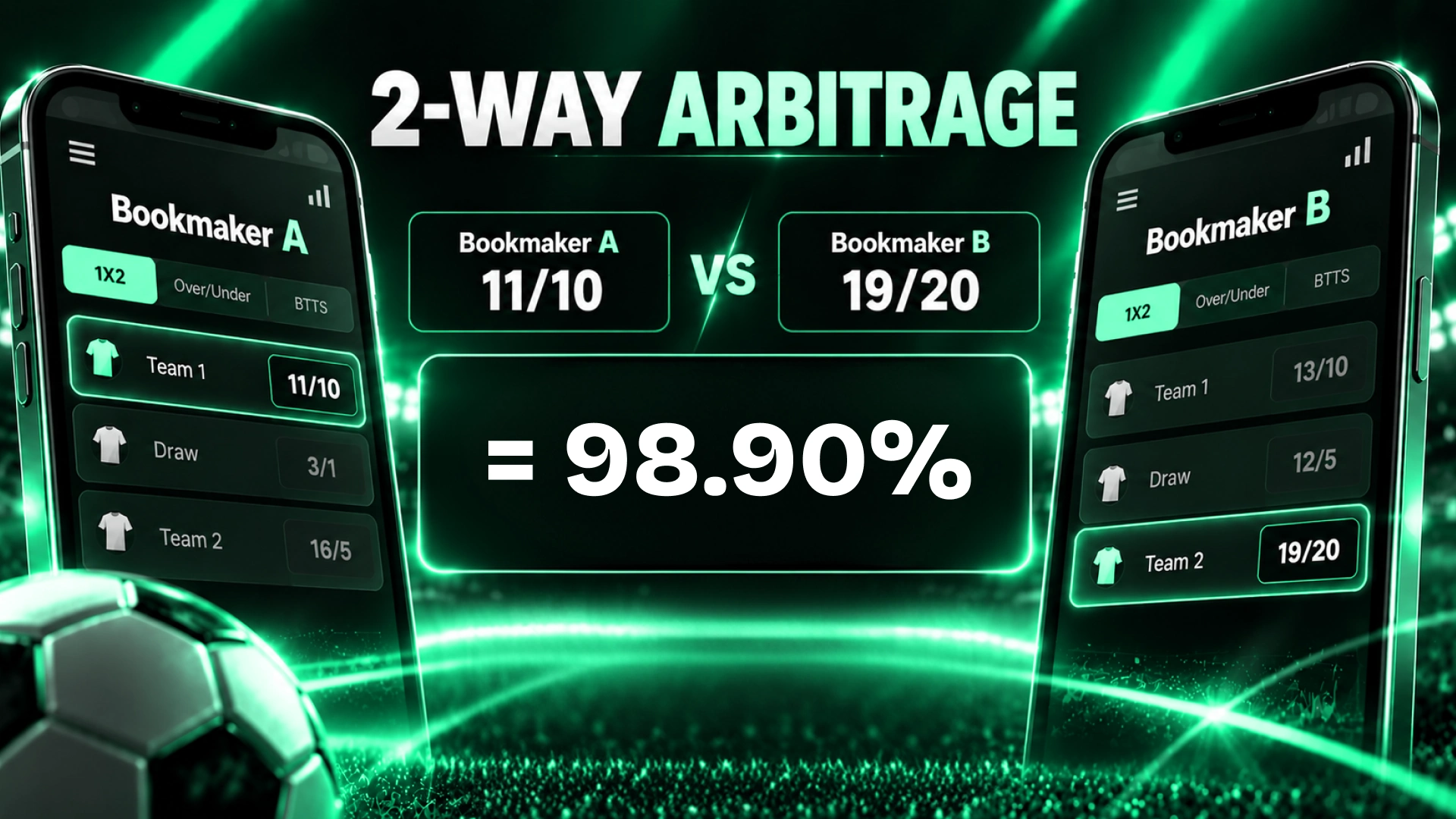
Bookmaker A prices Player A at 11/10 (2.10). Bookmaker B offers Player B at 19/20 (1.95).
The combined implied probability is:
(1 / 2.10) + (1 / 1.95) = 98.90%
An arbitrage calculator 2 way calculation gives the following stakes for a £1,000 bankroll.
| Selection | Fractional odds | Stake | Gross return |
| Player A | 11/10 | £481.48 | £1,011.11 |
| Player B | 19/20 | £518.52 | £1,011.11 |
| Total | £1,000.00 |
The minimum calculated profit is £11.11, approximately 1.11% of the total stake, after rounding to pennies.
Both bets must be accepted and settled under matching rules for that result to hold.
3-Way and 4-Way Arbitrage: When More Outcomes Are Involved
Football is the obvious example of a three-way market. A standard 90-minute match result includes a home win, draw and away win.
An arbitrage calculator 3 way calculation accounts for all three prices. Leaving out the draw would expose the bettor to a result that isn’t covered.
Four-way markets work the same way. An arbitrage calculator 4 way calculation needs four prices, each covering a distinct possible outcome. A four-runner outright market is one example, provided the market rules account for every settlement possibility.
More selections also mean more practical complications.
A two-way opportunity might require accounts with two bookmakers. A four-way opportunity could involve four separate operators, each with its own limits and rules.
Using several betting sites can make it easier to access different prices, but it doesn’t remove the timing problem.
If the third bookmaker changes its odds while the first two bets are already placed, the original calculation may no longer work.
How to Find Arbitrage Opportunities in 2026
Arbitrage opportunities appear when bookmakers disagree enough on their prices to bring the combined implied probability below 100%.
Finding those gaps takes comparison, particularly when odds move quickly before kick-off or during live events.
Odds Comparison
Arsenal might be priced at 6/4 with one bookmaker and 7/4 with another. The second price is better, but that alone tells nothing about arbitrage.
OddsScanner’s betting odds comparison tool helps identify the highest available prices across bookmakers. The next step is finding the best odds on the opposing outcomes.
For a standard football match result, that means comparing the home win, draw and away win. All three selections must cover the same 90-minute market and follow compatible settlement rules before their combined implied probability can be calculated.
Using Arbitrage Finder Software
By the time someone has checked six football matches across four bookmakers, the first set of prices might already be outdated.
Arbitrage scanners monitor odds feeds and flag combinations where the implied probabilities fall below 100%. They’re particularly useful for finding short-lived gaps that would be difficult to spot manually.
An alert showing a 2% margin still needs checking. The bookmaker might have shortened its odds, suspended the market, or limited the available stake. Settlement rules also need to match across every selection.
Exploiting Bookmaker Promotions and Odds Boosts
A football team boosted from 6/4 to 2/1 suddenly looks much more attractive. If the opposing outcomes remain available at their usual prices elsewhere, that promotion could create an arbitrage opportunity.
But a boost capped at £10 won’t support a £500 stake allocation. The maximum permitted wager matters as much as the enhanced odds.
The best free bets require extra care. Most don’t return the promotional stake, so a £20 free bet at 2/1 typically pays £40 in winnings rather than £60. Using the normal cash-bet formula would overstate the return.
Promotional eligibility, stake caps and settlement terms all need checking.
Risks and Limitations of Arbitrage Betting
A calculator shows £15 in potential profit on a £500 investment. Then the second bookmaker rejects the wager.
The first bet is still active, and the planned return no longer applies. Odds movement, account restrictions, and voided bets can all leave a bettor exposed to an outcome the original calculation was supposed to cover.
Account Limiting
(~70 words) Explain how sportsbooks track arbitrage patterns (e.g., irregular stakes, price A calculator might recommend placing £480 with one bookmaker and £520 with another. If the first operator accepts only £20, those figures are no longer usable.
Limits can apply to individual markets, promotions, or entire accounts. Bookmakers may also reduce maximum stakes or close accounts under their terms, particularly when betting patterns repeatedly exploit pricing differences.
Sometimes the restriction only becomes clear when a wager is submitted. That makes the available stake at each bookmaker a practical constraint on the calculation, regardless of how attractive the odds appear.
Odds Movement and Timing Risk
Imagine backing a tennis player at 11/10, then opening another bookmaker to place the opposing bet.
The second price has dropped from 19/20 to 4/5. The original arbitrage opportunity is gone, but the first wager remains active.
Markets can also be suspended before a counter-bet is accepted.
Another concern is a palpable error, sometimes called a palp. A bookmaker may void a wager placed at an obviously incorrect price under its terms.
If the opposing bet stands, the planned arbitrage position is no longer balanced.