










What Are Betting Odds and Why Do They Matter?
Betting odds puts a price on an outcome. They tell you roughly how likely the market thinks something is to happen and, more importantly for the bet itself, what you’ll get back if you’re right.
Take the same cricket section at 1.72 returns ₹1,720 from a ₹1,000 stake, while 1.65 returns ₹1,650. Same pick, ₹70 less.
We’ve evaluated online betting apps with that difference in mind because consistently taking the stronger price can add up over time.
How Odds Reflect Probability and Bookmaker Margin
A price of 2.00 isn’t just a potential payout. It represents an implied probability of 50%. Move to 1.50 and that rises to about 66.7%. That’s the other side of sports betting odds that’s worth understanding.
Add up the implied probabilities across a market and you’ll usually get more than 100%. The amount above 100% is the bookmaker margin, or overround.
A sportsbook can have an attractive price on one team while offering much less appealing numbers elsewhere in the same market.
What Are Really Good Odds?
Good betting odds aren’t simply big numbers. The price needs to stand up against what other sportsbooks are offering. On major IPL or Premier League match lines, a theoretical payout around 95%+ gives us a useful benchmark for competitive pricing.
That works out to an overround of roughly 5% or less. One excellent price can catch the eye, but we’d rather see what happens across 10 or 20 comparable markets. That’s much harder for consistently expensive pricing to hide.
Types of Odds Formats Explained
Three types of odds appear most often: decimal, fractional and American moneyline. Indian punters will generally find decimal the quickest to work with. No conversion is needed to see the potential total return.
Many betting sites let users switch formats, so understanding all three still helps when comparing prices across markets.
| Odds Format | Standard Regions | Example (Even Money) | How to Read & Calculate Payout |
| Decimal | Europe, India, much of Asia | 2.00 | Stake × odds = total return. |
| Fractional | UK, Ireland | 1/1 | Fraction shows profit relative to stake. |
| Moneyline (American) | US | +100 | Positive or negative number shows return around a 100-unit base. |
Decimal Odds (European Format)
Decimal is probably the quickest format to compare side by side. Multiply the stake by the odds and you have the total return, with the original stake already included.
Put ₹500 on a cricket selection at 1.80 and the return is ₹900, including ₹400 profit. Find 1.90 elsewhere and it becomes ₹950. Nothing about the selection changed.
The better price just pays ₹50 more.
Fractional Odds (UK Format)
Fractional odds work from profit rather than total return. See 3/2 and you’re being offered ₹3 profit for every ₹2 staked.
A ₹500 football bet at 3/2 therefore makes ₹750 profit and returns ₹1,250 altogether. Even money appears as 1/1. It’s not as quick to scan as decimal pricing, which is why we’d normally switch formats when comparing several sportsbooks at once.
Moneyline Odds (American Format)
American moneyline pricing takes a little longer to get used to. With a positive number, such as +150, a ₹100 stake makes ₹150 profit. Negative numbers work the other way around. At -200, you’d need ₹200 at risk to make ₹100.
Underdogs are usually shown with positive numbers and favourites with negative ones. For quick sportsbook comparisons, decimal is still easier to read.
How Odds Work in Sports Betting
Sports odds rarely stay fixed. Team news, injuries, weather, betting volume and fresh information can all move a market.
The interesting part is that sportsbooks don’t always react together. A team might shorten from 2.00 to 1.85 at one book while 1.95 is still available elsewhere. Those gaps can disappear quickly, so the comparison only means something when the market and settlement rules match.

What Does ‘Odds On’ Mean?
You’ll hear “odds-on” most often when discussing a favourite. In simple terms, odds in betting are odds-on when a winning bet makes less profit than the amount staked. In decimal format, that’s anything below 2.00.
A favourite at 1.50 is odds-on because ₹1,000 returns ₹1,500, a ₹500 profit. “Odds-against” means the potential profit is greater than the stake, such as 3.00, where ₹1,000 would return ₹3,000 in total.
Understanding Odds in Cricket
The odds meaning in cricket becomes clearer once the toss, pitch, and match situation enter the picture. A T20 price can move sharply after the toss if chasing conditions are expected to improve.
Live markets react even faster to wickets, boundaries, required run rate, and overs remaining. One expensive over can shift a total or match-winner line within seconds.
That’s why cricket rewards a fresh price check. Something that looked attractive before the toss can be poor value 10 minutes later, and a live number might last only a few deliveries.
How to Compare Odds Across Bookmakers — Step-by-Step
To compare odds properly, match the exact event, market, line, and settlement rules across sportsbooks. Small price gaps are important.
A ₹10,000 winning bet at 1.90 returns ₹19,000. Take 1.80 instead and it’s ₹18,000. That’s ₹1,000 left on the table even though the prediction was identical. The same price discipline matters when searching for best odds football markets or best odds cricket prices.
Over enough bets, those gaps stop looking small.
Using Odds Scanner’s Comparison Tool
Best odds comparison works better when the market comes first, not the sportsbook. On Odds Scanner, choose the sport and match, open the market you want and look across the available prices for that exact selection.
The close calls are where the comparison earns its place. A screen full of 2.05 prices makes a stray 2.15 easy to overlook, yet ₹5,000 at those two prices means a ₹500 difference in total return.
Check the settlement rules too. A higher number isn’t useful if you’re comparing two slightly different bets.
Comparing Live and Pre-Match Odds
Sometimes the best odds are there the night before. Sometimes they appear five minutes after play starts. Pre-match gives you time to compare margin and shop around without rushing.
Live prices don’t offer that luxury. A wicket, goal or red card can reset the market almost immediately. In cricket, even a six or a costly over can move the number before you’ve finished checking another sportsbook.
How to Calculate and Convert Odds
A price is more useful when you know what probability sits behind it. Sports betting odds of 2.50, for example, imply a 40% chance before bookmaker margin is considered.
That makes comparisons easier. You’re no longer looking at two numbers and guessing which one is attractive.
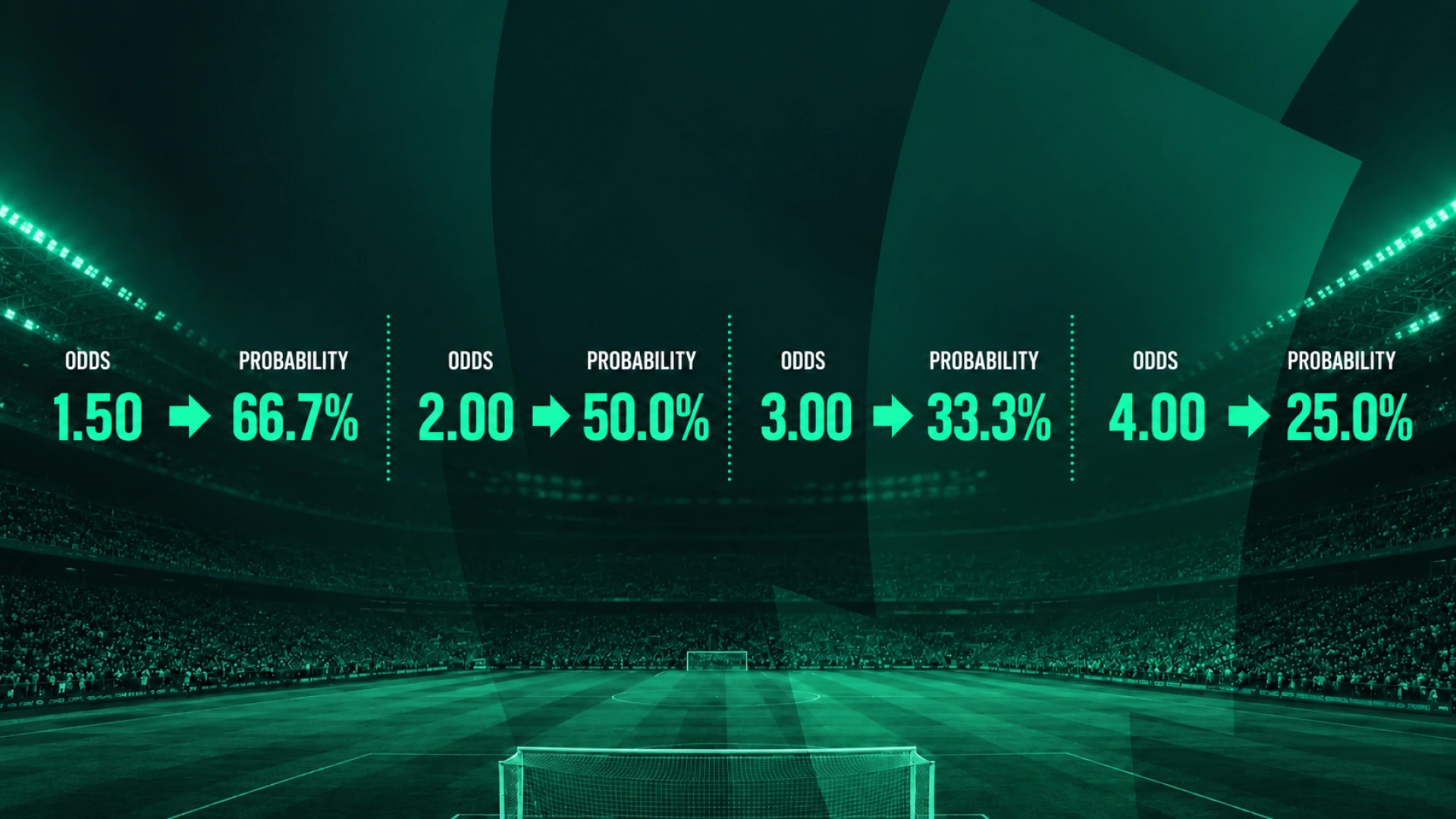
How to Convert Odds to Implied Probability
The decimal conversion only needs one formula:
Implied Probability % = 1 ÷ Decimal Odds × 100
So 2.50 becomes 40%, while 1.50 works out to roughly 66.7%. Treat that figure as the probability built into the price. It isn’t a prediction that four out of every 10 identical bets will win.
How to Convert Probability to Odds
To turn your own estimated probability into fair decimal odds, use:
Fair Odds = 100 ÷ Estimated Probability %
If you believe a team has a 50% chance of winning, fair odds are 2.00. A 40% estimate gives 2.50.
Now there’s something useful to compare against the sportsbook. Estimate a team at 40% and your fair number is 2.50. A quote of 2.30 would sit below that assessment, while 2.70 would sit above it.
The hard part is getting that 40% estimate right.
Factors Beyond Odds That Affect Your Winnings
Sports betting odds are only part of the return equation. A slightly higher price loses some appeal if the sportsbook has restrictive limits, awkward settlement rules or a low maximum payout.
Price still comes first in our comparison. It just can’t be the final check. A standout 2.10 loses some appeal if the sportsbook only accepts a tiny stake on that market or settles the bet differently from the book offering 2.05.
Understanding Overround and Bookmaker Margins
Here’s where checking only the headline price can fool you. Take a two-way market with both outcomes at 1.91. Each side carries an implied probability of about 52.36%, so together they reach 104.72%.
The overround is therefore about 4.72%.
Put both sides at 1.98 and the combined figure drops to roughly 101.01%. That’s a much tighter market. Overround isn’t the same as the bookmaker’s eventual profit, but for comparing pricing, it’s far more revealing than looking at one attractive selection in isolation.
Payout Caps, Fees, and Bet Limits
Seeing 2.20 instead of 2.10 looks great until the 2.20 price comes with a stake limit that makes it almost irrelevant. Maximum-win caps and account restrictions can create the same problem.
Smaller leagues and player props often have tighter limits than headline cricket or football markets.
Then there’s the cashier. Withdrawal minimums, processing rules and transaction charges can eat into an advantage found elsewhere. Someone regularly comparing prices should check these details once, rather than discovering them when it’s time to withdraw.
Odds Boosts and Promotions — How to Use Them Strategically
Betting odds can improve through enhanced-price offers, accumulator boosts, and selected free bets, but the headline number isn’t enough.
Our first check is the normal market price. After that come the boost, maximum stake, qualifying rules and expiry. A 20% enhancement isn’t especially useful if only a tiny stake qualifies.
A genuine boost can push a selection above its estimated fair price and, in some cases, overcome the normal bookmaker margin. Chasing a promotion by adding bets you didn’t want in the first place is a very different proposition.